Insight Foresight Institute

Transforming Innovation Ecosystems

  • About us
    • Our Community
    • Follow us and share
    • Contact us
  • Ecosystems
    • Corporates
    • Policymakers
    • Startups
  • Solutions
    • Activation & Alignment
    • Insight Foresight
    • Strategy & Governance
    • Training & Mentoring
    • Programming & Implementation
  • Sectors
    • Education
    • Research and Innovation
    • Services
    • Energy and Environment
    • Health and Social Care
    • ICT
    • Manufacturing
    • Transport and Infrastructure
  • Outreach
    • Press
    • Events
    • Videos
    • Reports
    • Position Papers
    • Follow us and share
  • English
    • Spanish
You are here: Home / Archives for Solutions / Solutions Insight

Foresight Case Study on Land Use Futures in Europe and Beyond

Insight Foresight Institute’s CEO Totti Könnölä, alongside Philine Warnke, led a Case Study, called “Land Use Futures” which explored how a strong focus on ecosystem flourishing could change the current thinking about land use competition. The study was part of the Foresight on Demand project ‘S&T&I for 2050: Science, Technology and Innovation for Ecosystem Performance – Accelerating Sustainability Transitions’ for the European Commission DG RTD.

STI 4.2 portada

Status Quo and System Change Analysis

The dynamics of change in global land use are explored from diverse perspectives. After briefly exploring the current distribution of land use, the focus moved to dynamic changes in ecosystems. These aspects are: de- and re-deforestation, land use for agriculture, land degradation, biofuel land use, land use for renewable energy, land use by mining and quarrying, land grab from rich to poor, and land health as an underlying driver of global pandemics, rewilding, land use for tourism, urban sprawl versus densification, floor space per person, human scale city planning and debate around public space ownership and publicness.

STI 4.2 img

Scenarios

Building on the analysis of the dynamic changes of land use, the experts developed three alternative scenarios for the future of land use.

Efficiency and optimisation of land use – Scenario P1: This scenario builds on the current trend of heavy exploitation of the land and it emphasises the optimal use of ecosystem services, especially using land for ensuring maximum production of food and other natural products and resources. Accordingly, land across the EU would be matched to the most appropriate use considering Europe in a globalised world with intensive movement of goods, capital, services and people. 

Towards Effective Multiple Use of Land – Scenario P2: In this scenario, society’s needs are met regionally in a coherent relationship between people and their resources. In this less globalised economy, there is a move towards regional autonomy. A Europe that has a greater appreciation of the resources that are available regionally and of the value of trying to live without external inputs, with the help of technological developments. Serving the regional population and keeping regional coherence are key priorities. This reduces the need for transportation and its negative effects. This scenario builds on emerging practices spinning around multiple land use, which refers to the use of land for more than one purpose, for example, grazing of livestock, recreation and timber production. 

Land use adapting to nature – Scenario P3: This scenario has emerged after a series of crises and system breakdowns in the context of the climate catastrophe. The economic, social and physical repercussions have halted economic growth and led to a reduction of life expectancy and shrinking of human population. As a means of survival humans are forced to seriously engage with ecosystems. In doing so they are building on the one hand on elements from Indigenous legal thinking about land such as property as “curation”, property as making kin, property as reconciliation, counselling with nature and on the other on early initiatives such as recognising rights of ecosystems or the forming of the “Loire Parliament”. 

STI Conclusions 

This case study examined three land use scenarios, revealing key trade-offs between efficiency and sustainability. The single-use approach maximises localised efficiency but risks ecosystem harm by ignoring systemic impacts. Multiple-use requires significant learning to integrate diverse practices across urban/rural contexts, while the immersive approach aligns with nature-based solutions and indigenous knowledge. The analysis highlights a necessary evolution: from P1’s land-efficient innovation (exploitative) to P2’s multi-functional use and ultimately P3’s nature-positive adaptation (symbiotic). These scenarios frame a crucial paradigm shift – moving from human-centric land exploitation to nature-adaptive relationships. 

Further information

Totti Könnölä and Philine Warnke. Case Study 2: Land Use Futures. In European Commission: Directorate-General for Research and Innovation, Klaus Kubeczko, Project Coordination, Michael Bernstein, Dana Wasserbacher, Beatrix Wepner, Philine Warnke, Totti Könnölä, Liviu Andreescu, Bianca Dragomir, Radu Cristian Gheorghiu, Carlo Sessa, Daniel Cassolà, Žilvinas Martinaitis – “S&T&I for 2050 Science, Technology and Innovation for Ecosystem Performance- Accelerating Sustainability Transitions”. Publications Office of the European Union, 2023.
Acess to full report
S&T&I for 2050 Science, Technology and Innovation for Ecosystem Performance- Accelerating Sustainability Transitions.

International analysis on mission-oriented instruments

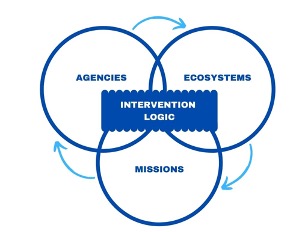
At the Insight Foresight Institute, we have recently conducted a study for ENISA – Empresa Nacional de Innovacion, S.A. on this subject focusing on initiatives launched by public sector entities. Our mapping points to initiatives that explicitly address mission orientation and ecosystem-based approaches to a greater or lesser extent. Our work helps to understand how mission-oriented innovation initiatives operate and everything that actually happens, from the pre-planning stages to the moment they are launched, and we start to see short- and long-term results, going through all the necessary economic, political and social organization and management to make each initiative happen.

International analysis on mission-oriented instruments


Today there is a growing global concern about economic, social and environmental issues, and therefore, different countries are trying to be actors of change and close the gap between just creating knowledge and actually taking action. Indeed, a series of decisive policy measures and efforts are needed to ensure that the innovation policies of the next generations are up to the challenges we are facing today. Focusing on mission orientation is a new challenge, but it is also a great opportunity. An opportunity motivated by the ambition to explore the ecosystem’s tools more broadly by leveraging the relationship with entrepreneurs and the notion of mission to move towards an optimal social position.  

Beyond generating economic growth, entrepreneurial ecosystems and innovation policies are increasingly expected to contribute to solving social challenges and that is why many of the mission-oriented innovation initiatives have as one of their key objectives to foster the implementation of the SDGs.

Innovation policies, therefore, seek to generate transformational change in society. However, attention must be paid to the possible areas of failure that arise when implementing these policies for change, which are directionality, policy coordination, demand-articulation and reflexivity. To achieve the objective of these policies, it is necessary to implement measures that ensure coordination between these policies and the different sectors of society to stimulate new development paths and increase solutions that better respond to challenges at a local, national, European and global level.

Missions have a great power of change that can also contribute to the development of ecosystems. It is essential to support entrepreneurship and understand the complexity of its operating environment to be able to offer help and resources efficiently. In this sense, the concept of ecosystem has great value in the entrepreneurship environment and refers to the above. It can be said that ecosystems involve an interrelationship between companies and their social, political, academic and economic environment, and depending on the environment this relationship will be more or less fluid. It is very difficult to determine these relationships independently, so it is more appropriate to address them all together. All these factors are considered and put in value when proposing mission-oriented innovation initiatives, since they are initiatives with enormous transforming power and before launching a project of this size it is necessary to be very conscious of all that it implies and all the elements that compose it in order to achieve the objectives set in an effective way.

The rationale elaborated above directs our mapping towards initiatives that explicitly address mission orientation and ecosystem-based approaches to a greater or lesser extent. Therefore, in this study, we have chosen to analyze different mission-oriented innovation initiatives from three different approaches that in practice often overlap.

  • On the one hand, we have research-driven, mission-oriented innovation initiatives with an emphasis on knowledge creation. These initiatives are mainly led by research organizations that address specific challenges with clear objectives, concrete deadlines and give enormous importance to the development of technology, as it produces a great social impact. In this section, we have included three initiatives that we have found very interesting, such as the Horizon Europe missions, the SFI challenges and the Vinnova challenge-driven innovation program.
  • On the other hand, we have industry-driven innovation ecosystem initiatives with an emphasis on knowledge application. These initiatives are led by large corporations involving diverse stakeholders to jointly address innovation and market creation, often in relation to poorly defined challenges. What differentiates this category from the other two is the existence of a mature business model and an effective industry structure at the international level. In this section, the initiatives chosen were the knowledge communities of the Institute of Innovation and Technology (EIT), the UK Catapult centres and the Canadian Superclusters.
  • Finally, we analyzed entrepreneurs-driven entrepreneurship ecosystem initiatives with an emphasis on market access and scaling up. These initiatives are driven by intermediary agents that improve the capabilities and general conditions for entrepreneurship. Likewise, other factors such as business creation and development support measures also seek to provide useful solutions to current social challenges. In this last section we have analyzed three other initiatives from three different areas of the world: Business Finland’s Growth Engines, Manizales-Mas in Colombia and Turkey’s SDG Impact Accelerator.

Therefore, in this study, nine public initiatives are analyzed in depth by adopting a longitudinal approach in terms of missions and based on six areas of analysis, namely the introduction and background of the initiative, its objectives and goals, the actors involved, the type of governance, the support mechanisms and the programming.

Each of the initiatives is unique in itself and presents characteristics that are very different from the rest, which are worth analyzing in detail and emphasizing as we do in the report. However, they also share some common features.

In some cases, the initiatives outsource the programming of the instruments used in the process. This can be cumbersome but is interesting to consider as it eases the administrative burden and incentivizes ecosystem coordination. Regardless of the emphasis on in-house or outsourced management practices, programming can benefit from incorporating several stages that allow for flexible reallocation of resources based on monitored performance. In line with the international trend, it would also be interesting to consider the possibility of establishing incentives and requirements for beneficiaries in other contexts within ecosystems.

Likewise, mission development is a complex process that requires the joint collaboration of various parties to achieve the desired outcome. In designing the procedures of an agency seeking to obtain and use intelligence in this process, it is very important to implement more directional, mission-oriented approaches. The reasons for selecting and prioritizing mission domains should be controlled through transparent communication among ecosystem actors. Ideally, these processes engage stakeholders in activities in which they participate jointly, but in which they not only create joint visions but also develop collaborative relationships to better address the joint challenges that arise.

It is therefore worth asking whether these innovation initiatives are an efficient and effective tool for change to address the economic, political, and social problems that arise daily in our society. Each one of them presents clear and defined goals that are already being carried out to a greater or lesser extent, thus meeting the challenges we face as a society. Every day there is more and more interest and concern worldwide to propose and carry out innovation policies that really lead us towards more inclusive and sustainable business and growth models. However, we need to invest even more in R&I and bet on mission-oriented instruments and initiatives aimed at creating systemic change in society.

You can download the full report free of charge below. For more information, please contact: info@if-institute.org. 

1/2021 IFI Report - Mission-oriented Instruments

FREE DOWNLOAD

Send download link to:

I confirm that I have read and agree to the Privacy Policy.

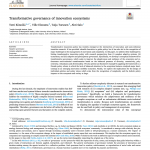
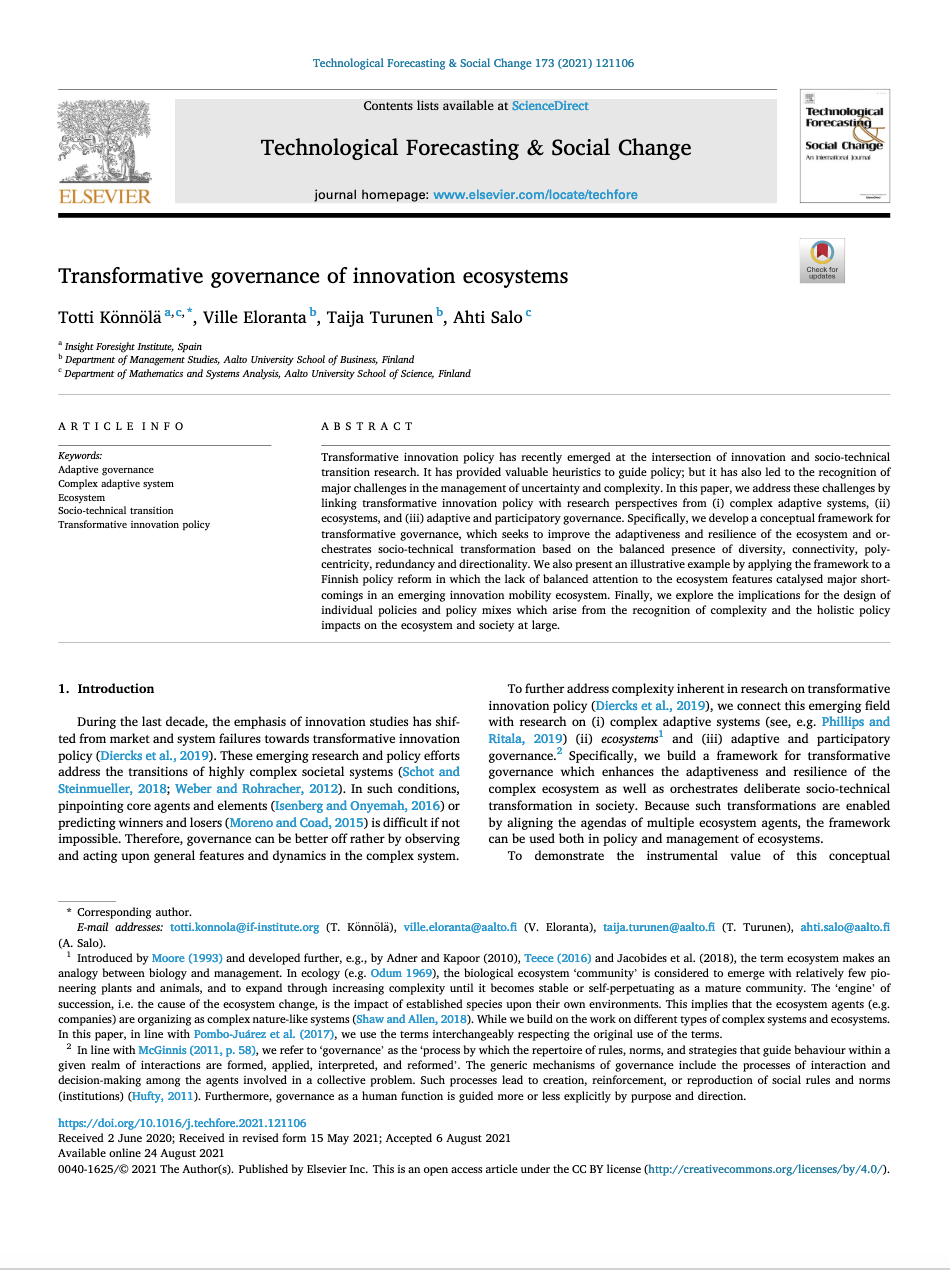
Transformative governance of innovation ecosystems

The CEO of IFI, Totti Könnölä publishes with Aalto University professors in a leading research journal ‘Technological Forecasting and Social Change’ a paper on transformative governance of innovation ecosystems.

Transformative governance of innovation ecosystems

New lens for policy and management

The framework of transformative governance developed in the paper, offers a powerful new lens for policy and management contexts which are characterised by complexity and uncertainty, both within vertical policies (e.g. research, energy, mobility or health) as much as within more horizontal policies (e.g. entrepreneurship or innovation). 

Apart from designing of specific policy measures, the framework can be harnessed for shaping the general conditions of transformative innovation policy and associated governance structures, for instance by overcoming bottlenecks related to both innovation and entrepreneurial ecosystems. Furthermore, it can be used for assessing and designing policy mixes to support the development of innovation ecosystems into desired directions. In fact, we look for new collaborations to apply this framework in policy/management analysis and the design of new measures.

Transformative innovation policy

The paper addresses transformative innovation policy, which has recently emerged at the intersection of innovation and socio-technical transition research. It has provided valuable heuristics to guide policy; but it has also led to the recognition of major challenges in the management of uncertainty and complexity.

Traditional policy responses to control markets have become a source of inertia and a point of vulnerability addressing challenges associated with digital platforms, financial crises and the covid-19 pandemic as well.

In this paper, we address these challenges by linking transformative innovation policy with research perspectives from (i) complex adaptive systems, (ii) ecosystems, and (iii) adaptive and participatory governance. Specifically, we develop a conceptual framework for transformative governance.

Transformative governance

Ecosystems tend to evolve towards excessive concentration of power and techno-institutional lock-ins, on the one hand, or the dissolution of the ecosystem to fragmented and chaotic markets, on the other. To address this challenge, we develop transformative governance.

Transformative governance seeks to improve the adaptiveness and resilience of the ecosystem and orchestrates socio-technical transformation based on the balanced presence of diversity, connectivity, polycentricity, redundancy and directionality.

In effect, the framework help design and assess policy measures which exhibit the desired five features in the three succession stages, thereby fostering more balanced ecosystem development.

Case study on emerging mobility ecosystem

We present an illustrative example by applying the framework to a Finnish policy reform in which the lack of balanced attention to the ecosystem features catalysed major shortcomings in an emerging innovation mobility ecosystem. Finally, we explore the implications for the design of individual policies and policy mixes that arise from the recognition of the complexity and the holistic policy impacts on the ecosystem and society at large.

The paper  results from the international Platform Value Now project, funded by Finland’s Strategic Research Council focusing on understanding the fast-emerging platform ecosystems, their value creation dynamics and requirements of the supportive institutional environment.

This paper is available here to download free of charge. For more information contact Totti Könnölä.

Könnölä et al. Transformative governance of innovation ecosystems

FREE DOWNLOAD

Send download link to:

I confirm that I have read and agree to the Privacy Policy.

National strategies and roadmaps for international R&I Cooperation

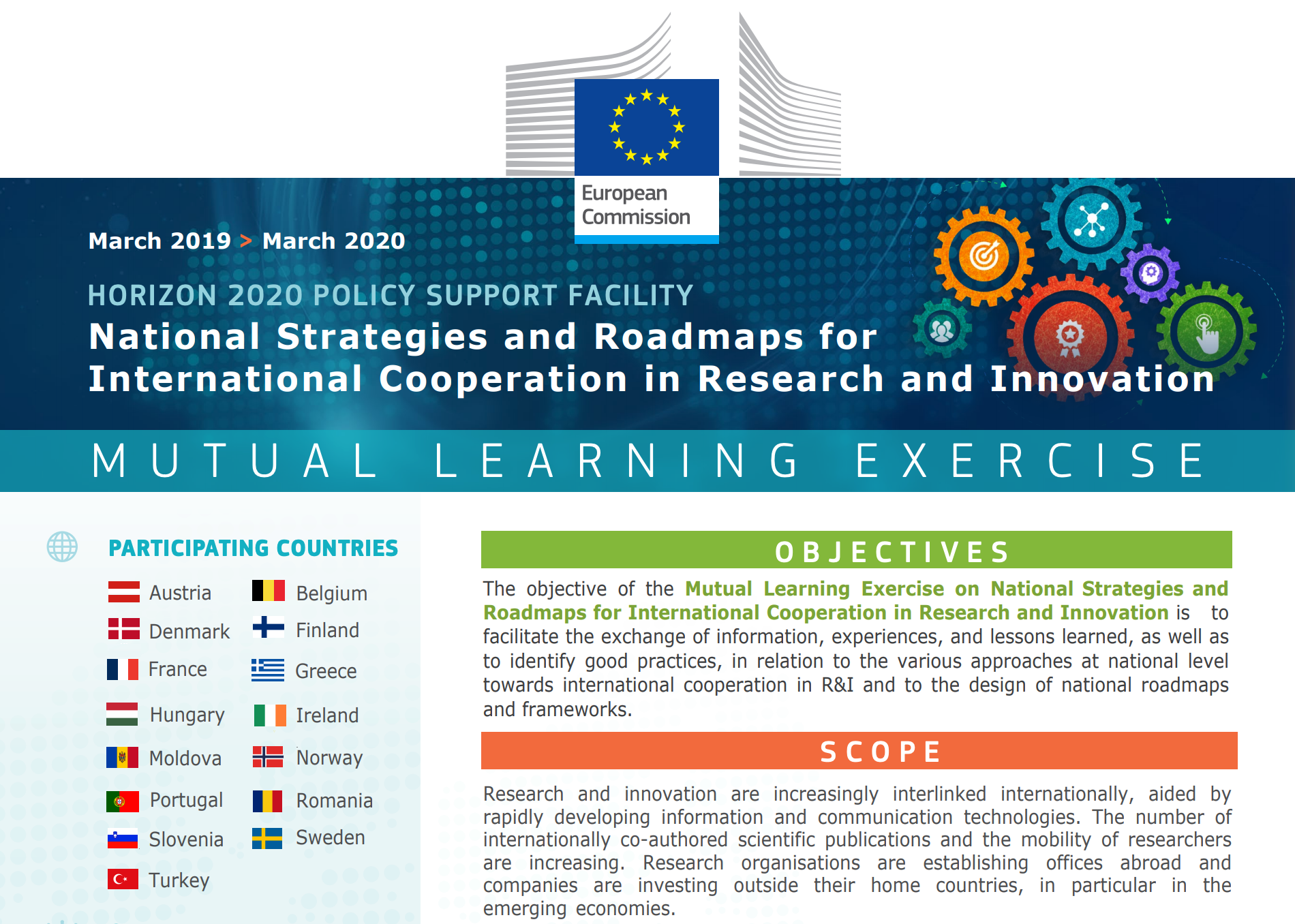
IFI supports the Member States to develop their Strategies and Roadmaps for International Cooperation in Research and Innovation. Totti Könnölä, CEO of IFI, participates in the expert panel of the Policy Support Facility for the European Commission. 

National strategies and roadmaps for international R&I Cooperation


Research and innovation are increasingly interlinked internationally, aided by rapidly developing information and communication technologies. Global challenges require global effort and dialogue with international partners. In this context, the aim of the MLE is to foster a policy exchange on the various national approaches towards international cooperation in research and innovation. The exercise allows for comparisons in terms of policy-making and helps identify inspiring novel practices while covering topics such as design and development of national strategies for international cooperation in research and innovation, implementing toolbox, framework conditions and challenge-driven international R&I cooperation.

For more information

Final report

Project website and deliverables


Foresight services to the European Commission

As part of the consortium led by the Austrian Institute of Technology, IFI supports the European Commission by providing “foresight on demand” services in science, technology, research and innovation policy.

Foresight services to the European Commission


DG Research and Innovation has set-up a “Foresight-On-Demand” (FOD) mechanism to respond to the demand for quick inputs to policy-making, drawn on the best available foresight knowledge. FOD is aimed at offering Commission services with timely and effective support related to crisis situations, emerging risks, and policy challenges. The FOD services will include scanning and synthesis of foresight literature and data sources including horizon scanning, rapid foresight data collection and analysis, scenario building, and combinations of the above. Within this framework, IFI is providing foresight support among others to the Mission Boards, European Environmental Agency and the Commission Scientific Advisory Mechanism and SAPEA.

  • 1
  • 2
  • 3
  • Next Page »

Insight Foresight Institute (IF-Institute)

C/ Isabel Colbrand 6, Quinta Planta.
28050 Madrid, Spain
info@if-institute.org
tel. +34 600842168


Copyright © 2026 · Insight Foresight Institute · Terms and Privacy · Cookies · Fotos: Shutterstock · info@if-institute.org · Tel. +34 600 842 168
  • English
  • Español
We use cookies to ensure that we give you the best experience on our website. If you continue to use this site we will assume that you are happy with it.