Insight Foresight Institute

Transforming Innovation Ecosystems

  • About us
    • Our Community
    • Follow us and share
    • Contact us
  • Ecosystems
    • Corporates
    • Policymakers
    • Startups
  • Solutions
    • Activation & Alignment
    • Insight Foresight
    • Strategy & Governance
    • Training & Mentoring
    • Programming & Implementation
  • Sectors
    • Education
    • Research and Innovation
    • Services
    • Energy and Environment
    • Health and Social Care
    • ICT
    • Manufacturing
    • Transport and Infrastructure
  • Outreach
    • Press
    • Events
    • Videos
    • Reports
    • Position Papers
    • Follow us and share
  • English
    • Spanish
You are here: Home / Archives for Solutions / Solutions Insight

Advise to Andalusia in the industrial transition towards carbon neutrality

The CEO of IFI, Totti Könnölä advises the Joint Research Centre of the European Commission in its work to support the Andalusian Government to create industrial transition towards carbon neutrality. Within the frame of the project RIS3 Support to Lagging Regions, the JRC has launched a Working Group on Understanding and Managing Industrial Transitions. 

Advise to Andalusia in the industrial transition towards carbon neutrality


The Working Group aims to support regional (and where appropriate national) authorities facing major industrial transitions, away from declining sectors and activities and charting actionable paths towards employment-intensive economic growth. The Working Group comprises of JRC staff, an Advisory Board and external experts engaged in reviews of industrial transition, coordinated by Ken Guy (Advisory Board Member of IFI).

The core activity of the Working Group are the reviews of industrial transition following a common methodology (POINT, Projecting Opportunities for INdustrial Transition) that draws on expertise on system innovation/transition management, foresight, industrial policy and innovation governance.

The reviews focus on an industrial theme of growing global importance suggested by the relevant territorial authorities (for instance, but not confined to: climate change, electrification of transport, circular economy, digitalisation, artificial intelligence) to collect evidence and examine the scope for developing adequate territorial responses that harness cross-portfolio complementarities (e.g. between ministries and between levels of governance) and cross-stakeholder coordination (e.g. between businesses and broad constituencies of consumers/users). In each territory under review and for an industrial theme suggested by the authorities the final report will:

(a) Map the affected orientation, resource mobilisation, production and consumption systems in the territory;

(b) Document existing planning arrangements and directions of deliberate change (e.g. as described in thematic policy and business strategies, or evident in momentum-gathering social concerns and movements, consumer trends,  common territorial values etc.) of various stakeholders in the affected systems that could later form the basis for a broadly-supported transition vision;

(c) Make concrete suggestions for the advancement of the transition and for managing its downsides. Given the nature and magnitude of the transition challenge, adequate territorial responses will include not just research and innovation policies that are already part of RIS3, but also industrial and employment policies more generally, including provisions for education and skills, for complementary large public infrastructures (e.g. in energy, transport, waste), urban planning, fiscal policy and social security reform, among others. Therefore the recommendations of the review will place a particular emphasis on fostering alignment and coordination within government.

The reviews aim to build the evidence base for appropriate “Actions to Manage Industrial Transitions”, as stipulated in fulfilment criterion No.6 of the enabling condition of good governance foreseen in the next multi-annual financing period of the EU Structural Funds (without prejudice to the final decision of the European Commission). The reviews can further inform RIS3 design and implementation (e.g. refining or extending priorities, broadening the EDP, fostering synergies with other funding streams) as well as informing, and been informed by, industrial policies and other territorial strategies for economic and social development. More broadly, it is hoped that the reviews can be an input to a participatory process of stakeholder engagement leading to the development of credible positive visions for the future that can be the source of pride and inspiration for the region (or country) and a rallying point for the mobilisation of actors and resources from all levels. 

The JRC plans to complete three such reviews (Andalucía, Bulgaria and Greece) in the current phase of the project in 2020.

For more information

Working Group on Understanding and Managing Industrial Transitions 
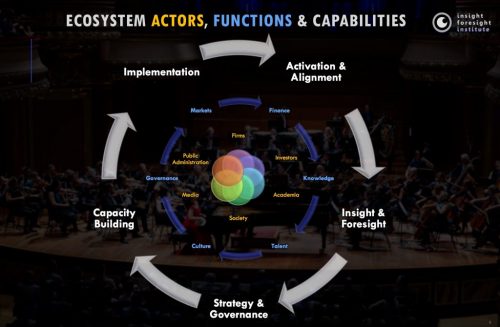
Towards Entrepreneurial Innovation Ecosystem in Montenegro

The European Commission expert panel applied the entrepreneurial innovation ecosystem model developed by IFI in expert advice in Montenegro. In this assignment, Totti Könnölä, CEO if IFI, was the rapporteur of the panel that was set up to provide external advice and operational recommendations on how the country could develop its entrepreneurial innovation ecosystem. 

Towards Entrepreneurial Innovation Ecosystem in Montenegro


The expert panel provided advice on the necessary legislative changes, the design of a functional entrepreneurial innovation and startup support ecosystem model and the necessary funding schemes for startups and other actors of the ecosystem.

For more information

The Commission project website
The final report available here for free

Is it possible to achieve smart specialization?

Juan Mulet Melia, a member of the Innovation Council of IFI, and Totti Könnölä, CEO of the Insight Foresight Institute (IFI), write in Cinco Días, one of the leading economic journals in Spain, to promote smart specialization in the regions.

The aim of any policy to promote innovation is to make more innovative companies, and those that already are, to address innovations that generate greater added value. An innovative company sees innovation as one of its operations in pure business logic. However, companies that are not innovative consider that it does not compensate them to assume the inherent risk of any innovation. For this reason, innovation policies will only be effective when they are able to reduce the technological, commercial, organizational or financial risk acceptable.
Two are the ways in which policies to promote innovation are usually pursued. One, of general application, is financial aid, which must be sufficient to make the risk acceptable to a company that feels averse to innovation. The safest way to waste public money is to design financial policies for innovation with scarce resources.
The second path is to facilitate access to the technologies needed to develop innovations. If there are already sources of adequate technology, this path will be less expensive, but only reduce the technological risk, leaving intact commercial, organizational and financial…

Link to full article

Image: Gitty Images / Cinco Dias

Corporative Innovation in Spain: Entrepreneurship, Innovation & Venturing

Insight Foresight Institute has prepared a research on corporate innovation in Spain in connection with the E2I2 Forum (Education, Entrepreneurship, Innovation and Investment) coordinated by the Royal Academy of Engineering. The project consisted of: i) a study of the literature on intrapreneurship, innovation and corporate entrepreneurship, iii) verification of the data with public material, and iv) the final report.
There are several ways to approach entrepreneurship in corporations in Spain:
1. Do not carry out these activities: 9 companies of those consulted. Fundamentally in the Media sector and in the project oriented companies.
2. Intrapreneurship promotion: 17 companies consulted. Fundamentally based on employee ideas competitions.
3. Encourage external entrepreneurship: 16 companies consulted. Investment in new companies, customer cooperation, external ideas competitions, event sponsorship.
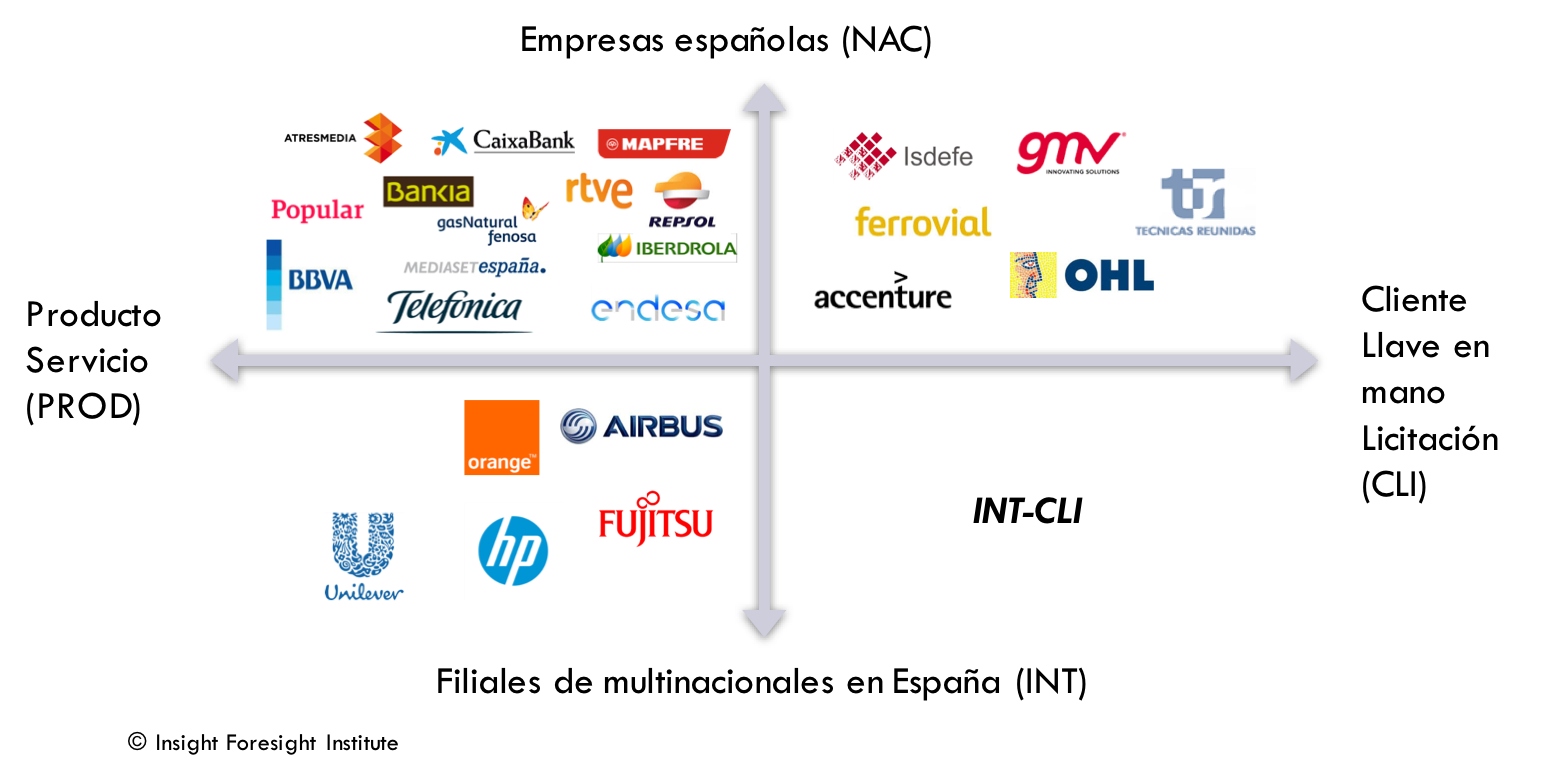
Based on the quantitative indicators consulted, it has been verified that some differences in the concrete dimensions that have been interesting to highlight (Image 1):
• Companies focused on the development and sale of products / services in front of companies focused on client projects (turnkey, tenders, etc …).
• Companies with corporate headquarters in Spain against subsidiaries of foreign companies.

Figure 1. Distribution of companies interviewed according to type of sales and location of corporate headquarters.
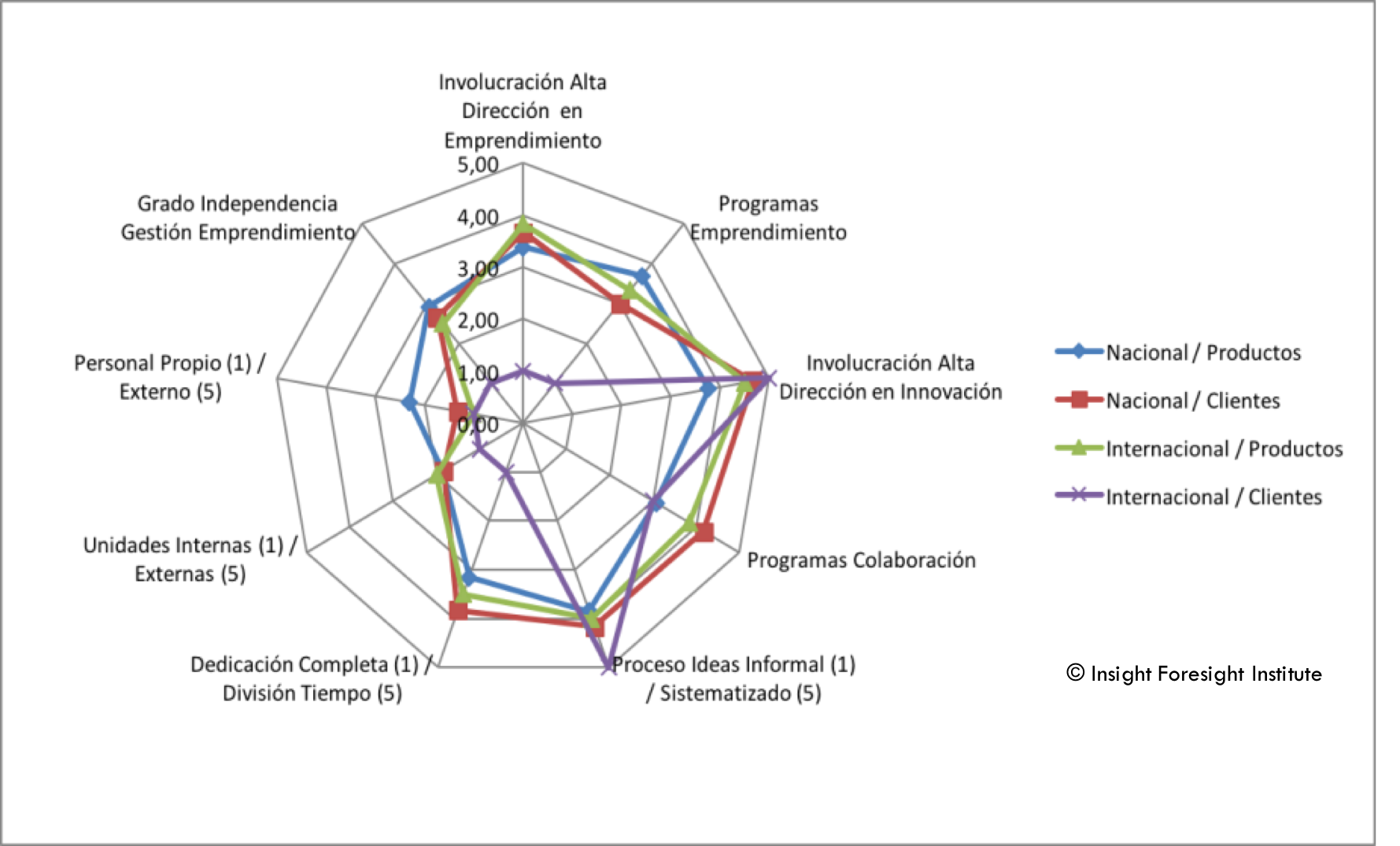
The behavior regarding entrepreneurship, ideas management and innovation offers some nuances according to the quadrant that is observed (Image 2).

Figure 2. Positioning of the interviewed companies regarding their activities of ideas management, innovation and entrepreneurship.

Barriers perceived in companies to innovate can be grouped into external barriers, such as: (i) low entrepreneurial culture at country level; (ii) deficiencies in the education system and knowledge generation; (iii) poor public support and regulatory constraints; and (iv) difficulties in the financing of these activities, and internal barriers such as (i) Enterprise culture and vertical structures. Excessive internal bureaucracy; (ii) Financial bias in decision-making. Lack of innovation indicators and iii) Operational problems: Selection of non-entrepreneurial personnel and unchanging processes.
It can be concluded that there is great predisposition to entrepreneurship and innovation but little radical and disruptive innovation. Companies have specific units of high level corporate innovation, but also innovation in vertical units. The importance of ecosystem management is recognized. Intrapreneurship activities are carried out without specific remuneration in most cases. If it occurs, in kind and promotion. There is a broad interest in indicators: i) Process: efficiency and effectiveness of projects, ii) Strategic: most used, iii) Financial: main interest. Limitations by traceability.
To know the concrete results of the study, send us an email: info@if-institute.org

The European car industry has to catch up

image©Cinco Días/Thinkstock

Francisco Jariego, a member of the Innovation Council of IFI, and Totti Könnölä, CEO of Insight Foresight Institute (IFI), write in Cinco Días (one of the leading economic journals in Spain) about the transformation in the automotive industry driven by technological advances and the platform economy.

Smartphones have opened the possibility of sharing vehicles in a simple way. Uber and others have developed platforms that connect drivers and passengers, making it possible to find a driver or share a car with just a one click. These companies are pushing for a change in the patterns of private car use, which will have important consequences.

The electric vehicle is reaching the levels of autonomy and cost that make it competitive with the vehicles of internal combustion. Tesla has strongly encouraged the development of this type of vehicle with a huge investment in the production of electric batteries and a coordinated bet on the development of solar energy.

The autonomous vehicle begins to be accepted as a real possibility in a not too distant future. After years of investing in the technologies that will make a driverless vehicle possible, what began as a highly speculative bet from Google (a moonshot) is, since late 2016, a new business unit, Waymo, under the umbrella of Alphabet.

Read the full article in CincoDias in Spanish.


  • « Previous Page
  • 1
  • 2
  • 3
  • Next Page »

Insight Foresight Institute (IF-Institute)

C/ Isabel Colbrand 6, Quinta Planta.
28050 Madrid, Spain
info@if-institute.org
tel. +34 600842168


Copyright © 2026 · Insight Foresight Institute · Terms and Privacy · Cookies · Fotos: Shutterstock · info@if-institute.org · Tel. +34 600 842 168
  • English
  • Español
We use cookies to ensure that we give you the best experience on our website. If you continue to use this site we will assume that you are happy with it.