Insight Foresight Institute

Transforming Innovation Ecosystems

  • About us
    • Our Community
    • Follow us and share
    • Contact us
  • Ecosystems
    • Corporates
    • Policymakers
    • Startups
  • Solutions
    • Activation & Alignment
    • Insight Foresight
    • Strategy & Governance
    • Training & Mentoring
    • Programming & Implementation
  • Sectors
    • Education
    • Research and Innovation
    • Services
    • Energy and Environment
    • Health and Social Care
    • ICT
    • Manufacturing
    • Transport and Infrastructure
  • Outreach
    • Press
    • Events
    • Videos
    • Reports
    • Position Papers
    • Follow us and share
  • English
    • Spanish
You are here: Home / Archives for Solutions / Solutions Governance

Scenarios On Healthy Oceans, Seas and Coastal and Inland Waters for the Horizon Europe Mission Board

Insight Foresight Institute’s CEO, Totti Könnölä, supported by the experts Ferdinando Boero, Denis Lacroix, Andreas Ligtvoet and Evangelos Papathanasiou and 4Strat, led the foresight project “Support to the Mission Board Healthy Oceans, Seas, Coastal and Inland Waters”, developed by the Foresight on Demand consortium for the Directorate-General for Research and Innovation of the European Commission.
Screenshot

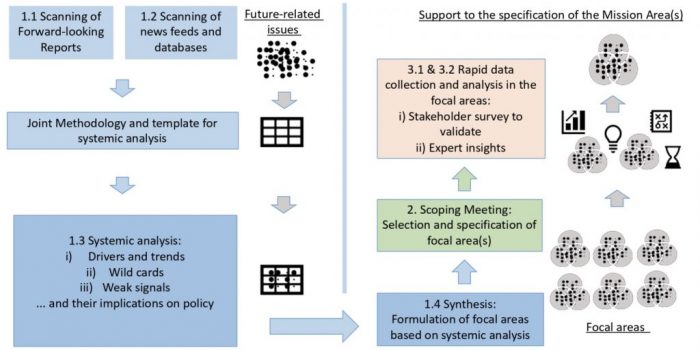
Using foresight methodologies — including horizon scanning, weak-signal detection and a real-time Delphi study — the team identified five focal areas representing alternative but interconnected pathways for action:

  • Climate-resilient coastlines: adapting to unavoidable sea-level rise and extreme weather events across Europe.
  • Clean water for the blue planet: halving industrial nutrients, plastics, pharmaceuticals and pesticides in European waters by 2030.
  • Vital aquatic ecosystems: harmonising ecology and economy in decision-making to protect biodiversity and sustainable productivity.
  • Open digital twin of oceans and waters: integrating real-time data for observation, early warning and ecosystem management.
  • Humans at sea: piloting sustainable living, aquatic production and circular design in semi-permanent floating structures.
Screenshot

The Delphi results showed broad consensus on the urgency to restore water health and adopt an ecosystem-based governance approach. Participants emphasised the need to strengthen biodiversity research, improve coordination between marine and inland policies, and enhance monitoring of pollution sources.

Main recommendations:

  1. Adopt a holistic approach and promote water literacy across all sectors of society.
  2. Create multi-stakeholder networks using shared and accessible language that bridges inland and ocean waters.
  3. Develop integrated impact assessment and continuous monitoring systems to prevent unintended effects on complex ecosystems.

This work positions Europe as a global leader in achieving resilient coasts, clean waters and sustainable blue economies, aligning scientific foresight with tangible societal transformation.

Further information

Totti Könnölä, Ferdinando Boero, Denis Lacroix, Andreas Ligtvoet, Evangelos Papathanasiou
“Mission Area: Healthy Oceans, Seas and Coastal and Inland Waters – Foresight on Demand Brief in Support of the Horizon Europe Mission Board.”European Commission – Directorate-General for Research and Innovation, Foresight on Demand series. Publications Office of the European Union, 2021. ISBN 978-92-76-41537-4.

Acess to full report
Mission Area: Healthy Oceans, Seas, and Coastal and Inland Waters — Foresight on Demand Brief in Support of the Horizon Europe Mission Board. Publications Office of the European Union, 2021. doi:10.2777/054595. ISBN 978-92-76-41537-4.

Geopolitical & industrial decarbonisation scenarios to identify R&I opportunities for the EU

As part of ‘the Eye of Europe’ Horizon Europe Project, Insight Foresight Institute organised an in-person stakeholder workshop on ‘Geopolitical & industrial decarbonisation scenarios to identify R&I opportunities for the EU’ on 10-11 April 2025 in Madrid, Spain. The event consisted of debating around a primary issue on the EU’s agenda: how to navigate geopolitical issues to keep decarbonising the continent towards sustainable and competitive sectors. 

Wokshop image1

The workshop gathered more than 30 experts specialised in different areas related to circular economy, decarbonisation, sustainability, innovation, geopolitics etc. The objective was to use foresight methods (scenarios and roadmaps) in order to plan different strategies to navigate industrial decarbonisation. For that matter, three different small groups were created:  

  • Energy Security and Supply moderated by Attila Havas.
  • Critical Raw Materials moderated by Totti Könnölä.
  • Manufacturing in Hard-to-Abate Sectors moderated by Karl-Heinz Leitner.
Wokshop image2
Workshop Image3

Participants attended this two-day workshop which started with introductory presentations by experts from public institutions such as the European Commission or the Spanish Ministry of Industry. Once participants were put into context, the common scenario work began in the mentioned small groups. The second day, the debate was focused on roadmpaping for R&I needs and emerging areas. The findings and conclusions were gathered in the final plenary and will soon be published on a report.

Workshop Image4
Workshop Image5

The dynamic teamwork carried out by participants with such different backgrounds allowed to gather diverse outcomes from the exercise. The decarbonisation process of the European industry has already begun, and it is crucial to consider every factor in order to apply the adequate strategies. From the Insight Foresight Institute’s team we would like to thank all the participants that attended those two days to debate about the future of the decarbonisation process in Europe.

Outcomes 

The workshop structured “what-if” geopolitical context scenarios in plenary, and co-constructed in break-out sessions thematic scenarios before switching to a back-casting/ road-mapping sprint, where teams mapped priority research and innovation levers, time-sequenced milestones, and critical policy enablers. This integrated context and thematic scenario work plus road-mapping workflow proved efficient at converting long-range uncertainty into actionable R&I agendas. Its low-tech, dialogue-centred design makes it readily transferable to other domains (e.g., circular-economy transitions, digital sovereignty, climate-adaptation finance). Embedding this type of work as a standing module in EU and national programme formulation could help institutionalise anticipatory thinking, ensure that R&I investments remain robust across multiple futures, and continually refresh cross-sector stakeholder networks. 

The workshop leaves no doubt: the EU’s race to net-zero will be played in a hard-edged geopolitical arena. Whether the world turns truly collaborative, reluctant to cooperate, or openly hostile, energy, materials, and heavy industry sit at the top of the agenda. The discussions showed that resilience and decarbonisation are now aligned goals. The EU therefore, needs clean-tech supply chains that can flex with shocks, a grid designed as critical defence infrastructure, and industrial processes able to swap feedstocks overnight. In short, future competitiveness will depend less on today’s cost curves and more on how fast our systems can pivot when the global weather changes. 

Three levers stood out for research and innovation:

  1. Scale green hydrogen, long-duration storage and AI-optimised electro-markets so electrons and molecules move across borders as simply as data.
  2. Close the raw-materials loop: mine the urban stock, build plants that treat scrap like ore, and bankroll chemistry that cuts out scarce metals altogether.
  3. Turn heavy industry into a modular “plug-and-play” platform—electrified kilns, hydrogen in direct reduced iron production, high-entropy alloy printers—so the EU can make steel, cement, and chemicals even if trade routes freeze. Each lever works best when knowledge is shared, regulation is quick and carbon footprints are tracked in real time. 

For the EU’s R&I policy this means a pivot from cautious projects to bold, scenario-tested portfolios. Horizon Europe’s successor should twin every big grant with a stress-test against multiple geopolitical futures, back open-source patents that widen options for the EU, and fund pilot lines that can be repurposed at speed. Defence, trade, and climate teams better sit at the same table when calls are drafted, while public procurement and emissions trading system (ETS) revenues give innovators the early markets they need. Agile, mission-driven programmes, deep data transparency, and a sharper focus on circular substitution could place the Union where it needs to be: ahead of the curve, whatever the world throws at it. 

Additional information

Totti Könnölä. “Geopolitics of Industrial Decarbonisation Workshop Report on Global Scenarios and R&I Opportunities for Europe”, Eye of Europe, Madrid, April 10-11, 2025

Acess to full report
Totti Könnölä. “Geopolitics of Industrial Decarbonisation Workshop Report on Global Scenarios and R&I Opportunities for Europe”, Eye of Europe, Madrid, April 10-11, 2025

Futures of Science for Policy in Europe: Scenarios and Policy Implications

Insight Foresight Institute participated in the Foresight on Demand consortium studying “Futures of Science for Policy in Europe: Scenarios and Policy Implications”. The study developed key trends shaping the future of science-for-policy ecosystems in the European Union, analyzing challenges and opportunities arising from the growing role of scientific advice in public decision-making. The work was part of the larger platform project named “European R&I Foresight and Public Engagement for Horizon Europe” for the European Commission, coordinated by Totti Könnölä, the CEO of Insight Foresight Institute. 

Science portada

The report explores how knowledge should be exchanged between actors and policy-makers to strengthen scientifically informed policies in Europe. Science is increasingly visible in public debates, and governments are more willing to mobilize diverse advice mechanisms. However, this creates tensions around the control of knowledge production, responsibility for decisions, and the integration of both expert and lay knowledge. 

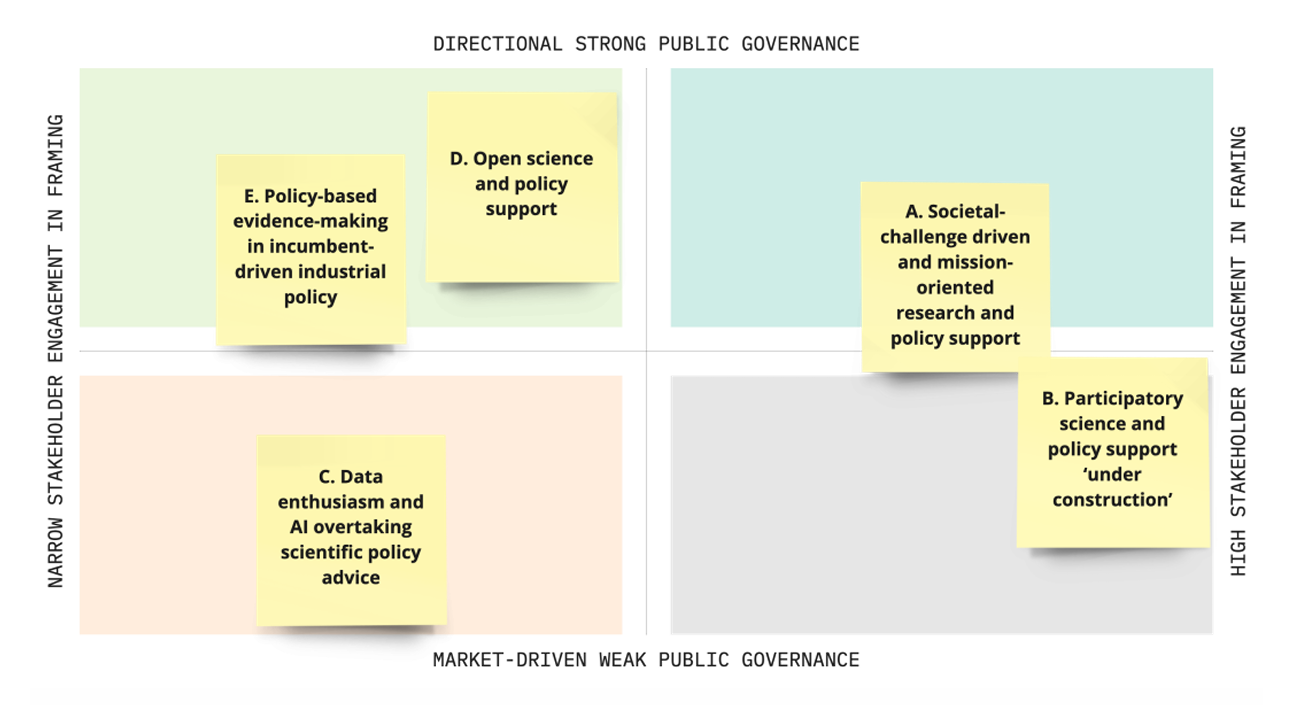
Five scenarios for 2030 illustrate alternative futures for science-for-policy ecosystems: 

  • Scenario A – Mission-oriented research and policy: Science and policy align around societal challenges, fostering co-creation and stakeholder collaboration, while raising questions about risks for traditional disciplines. 
  • Scenario B – Participatory science and policy ‘under construction’: Citizens, NGOs, and grassroots actors gain influence in shaping research and advice, challenging established institutions and broadening the notion of evidence. 
  • Scenario C – Data enthusiasm and AI dominance: Over-reliance on AI and multinational data providers risks transparency, autonomy, and critical reflection in scientific advice. 
  • Scenario D – Open science and policy support: Open science strengthens transparency and access to knowledge, but also highlights the need for protected spaces where unpopular yet rigorous opinions can be expressed. 
  • Scenario E – Policy-based evidence-making in industrial policy: Incumbent-driven strategies prioritize corporate interests, embedding advice mechanisms within government agencies but risking bias and reduced innovation diversity. 
Science 1

Across these scenarios, the study identifies key policy implications:

  • Science-for-policy ecosystems must balance inclusiveness with quality, safeguarding resilience against populism and corporate capture.
  • Deliberation and alignment of public policies which would enable the interaction betweem knowledge production and decision.
  • A value-based approach is essential, recognizing that science is not neutral and should engage openly with ethical and societal debates.

This work highlights the dynamic relationship between science and democracy in Europe. Open, pluralistic, and future-oriented science-for-policy ecosystems can foster responsibility, accountability, and resilience in addressing societal challenges. 

Additional information

Leena Sarvaranta, Albert-Bravo-Biosca, Bruna De Marchi, Rene Von Schomberg, Matthias Weber and Totti Könnölä. “Futures of Science for Policy in Europe: Scenarios and Policy Implications”. Publication Office of the European Union, 2024.

Acess to full report
Futures of Science for Policy in Europe: Scenarios and Policy Implications

Futures of Using Nature in Rural and Marine Europe in 2050: Scenarios and Policy Implications

The CEO of Insight Foresight Institute, Totti Könnölä, coordinated this project of the Foresight on Demand consortium. The project explored transformative scenarios for Europe’s rural and marine areas in 2050, examining their implications for current R&I policy across four critical dimensions: (i) Economy and technology, (ii) Demographics, lifestyles and values, (iii) Governance, and (iv) Environmental sustainability. The aim was to analyse how the Anthropocene’s accelerated social and technological changes—particularly the extensive use and misuse of Earth’s resources—might reshape Europe’s territorial development pathways, and to derive actionable policy insights for sustainable transition. 

Using nature portada

The project was one of eight Deep Dive Foresight Studies in the project ‘European R&I Foresight and Public Engagement for Horizon Europe’. The expert team identified factors of change and organised two scenarios and one policy implications workshops, also engaging experts from academia, business and public administration around Europe. The process was also supported by discussions in the Horizon Europe Foresight Network. 

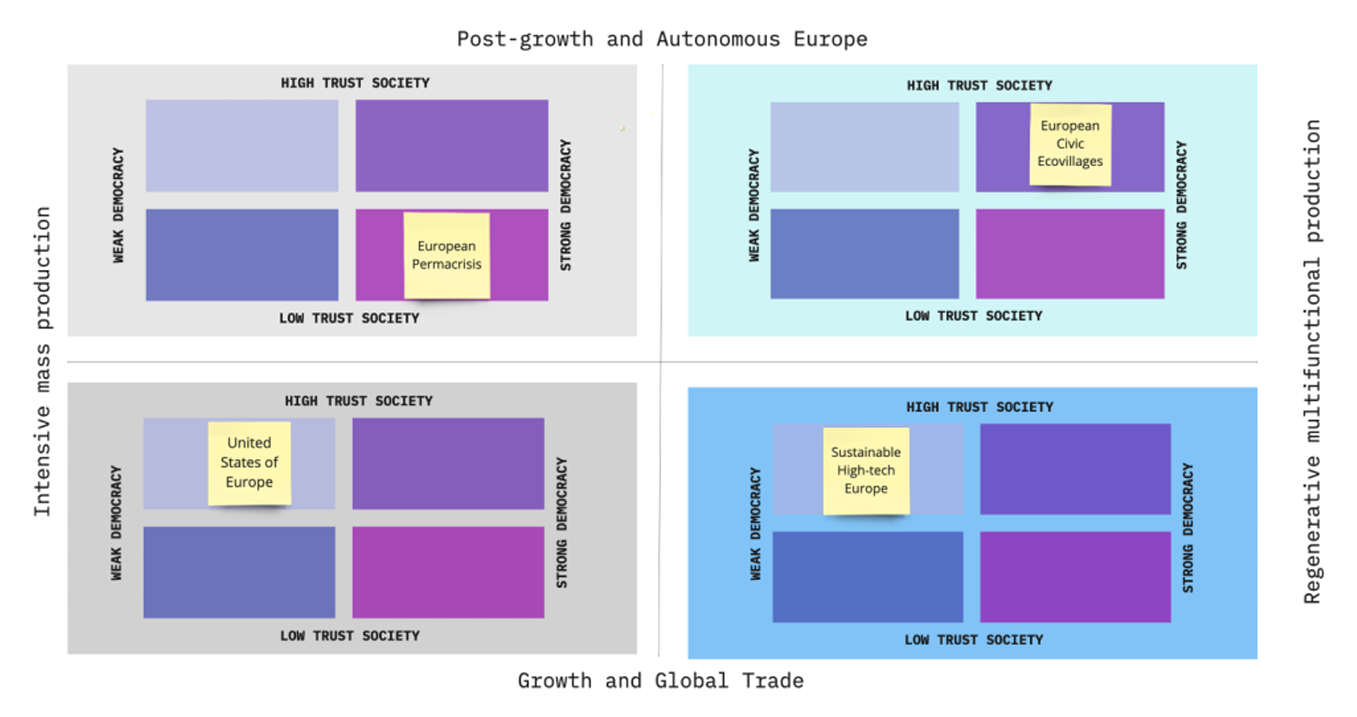
The foresight project developed four scenarios of Europe’s rural and marine futures by 2050: 

  • Scenario A – European Civic Ecovillages: Local communities pursue self-sufficiency and cooperative economies, restoring ecosystems on land and sea but focusing mainly on regional crises. 
  • Scenario B – Sustainable High-tech Europe: European businesses achieve global leadership in regenerative high-tech solutions, yet face barriers to scaling up and achieving systemic biodiversity gains. 
  • Scenario C – United States of Europe: A centrally planned model balances intensive land and sea use with large conservation zones, creating positive impacts on biodiversity but limiting decentralization. 
  • Scenario D – European Permacrisis: A fragmented, post-growth Europe struggles with political division, weak innovation, and ineffective biodiversity protection. 
Using nature1

Policy implications included: 

  • Tackling risks of fragmented land use that weaken ecosystems and reduce resilience. 
  • Advancing integrated spatial planning of urban, rural, and marine areas, including extended user rights and new ownership models. 
  • Balancing sustainability with affordability and food security in agriculture and aquaculture. 
  • Developing both local and global solutions to climate and biodiversity crises, ensuring scalability and coherence. 

The scenarios underlined that no single solution can fully resolve global climate and biodiversity challenges. Instead, Europe must foster balanced, multi-level approaches that combine innovation, governance, and inclusive societal engagement to ensure resilience and sustainability. 

Additional information

Totti Könnölä, Martha Bakker, Francois Simard, David Shaw, Philine Warnke. “Futures of Using Nature in Rural and Marine Europe: Scenarios and Policy Implications ”. Publications Office of the European Union, 2024. 

Acess to full report
Futures of Using Nature in Rural and Marine Europe in 2050: Scenarios and Policy Implications

International analysis on mission-oriented instruments

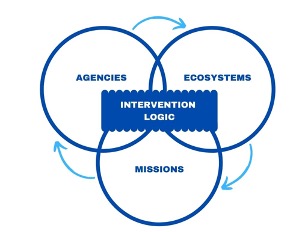
At the Insight Foresight Institute, we have recently conducted a study for ENISA – Empresa Nacional de Innovacion, S.A. on this subject focusing on initiatives launched by public sector entities. Our mapping points to initiatives that explicitly address mission orientation and ecosystem-based approaches to a greater or lesser extent. Our work helps to understand how mission-oriented innovation initiatives operate and everything that actually happens, from the pre-planning stages to the moment they are launched, and we start to see short- and long-term results, going through all the necessary economic, political and social organization and management to make each initiative happen.

International analysis on mission-oriented instruments


Today there is a growing global concern about economic, social and environmental issues, and therefore, different countries are trying to be actors of change and close the gap between just creating knowledge and actually taking action. Indeed, a series of decisive policy measures and efforts are needed to ensure that the innovation policies of the next generations are up to the challenges we are facing today. Focusing on mission orientation is a new challenge, but it is also a great opportunity. An opportunity motivated by the ambition to explore the ecosystem’s tools more broadly by leveraging the relationship with entrepreneurs and the notion of mission to move towards an optimal social position.  

Beyond generating economic growth, entrepreneurial ecosystems and innovation policies are increasingly expected to contribute to solving social challenges and that is why many of the mission-oriented innovation initiatives have as one of their key objectives to foster the implementation of the SDGs.

Innovation policies, therefore, seek to generate transformational change in society. However, attention must be paid to the possible areas of failure that arise when implementing these policies for change, which are directionality, policy coordination, demand-articulation and reflexivity. To achieve the objective of these policies, it is necessary to implement measures that ensure coordination between these policies and the different sectors of society to stimulate new development paths and increase solutions that better respond to challenges at a local, national, European and global level.

Missions have a great power of change that can also contribute to the development of ecosystems. It is essential to support entrepreneurship and understand the complexity of its operating environment to be able to offer help and resources efficiently. In this sense, the concept of ecosystem has great value in the entrepreneurship environment and refers to the above. It can be said that ecosystems involve an interrelationship between companies and their social, political, academic and economic environment, and depending on the environment this relationship will be more or less fluid. It is very difficult to determine these relationships independently, so it is more appropriate to address them all together. All these factors are considered and put in value when proposing mission-oriented innovation initiatives, since they are initiatives with enormous transforming power and before launching a project of this size it is necessary to be very conscious of all that it implies and all the elements that compose it in order to achieve the objectives set in an effective way.

The rationale elaborated above directs our mapping towards initiatives that explicitly address mission orientation and ecosystem-based approaches to a greater or lesser extent. Therefore, in this study, we have chosen to analyze different mission-oriented innovation initiatives from three different approaches that in practice often overlap.

  • On the one hand, we have research-driven, mission-oriented innovation initiatives with an emphasis on knowledge creation. These initiatives are mainly led by research organizations that address specific challenges with clear objectives, concrete deadlines and give enormous importance to the development of technology, as it produces a great social impact. In this section, we have included three initiatives that we have found very interesting, such as the Horizon Europe missions, the SFI challenges and the Vinnova challenge-driven innovation program.
  • On the other hand, we have industry-driven innovation ecosystem initiatives with an emphasis on knowledge application. These initiatives are led by large corporations involving diverse stakeholders to jointly address innovation and market creation, often in relation to poorly defined challenges. What differentiates this category from the other two is the existence of a mature business model and an effective industry structure at the international level. In this section, the initiatives chosen were the knowledge communities of the Institute of Innovation and Technology (EIT), the UK Catapult centres and the Canadian Superclusters.
  • Finally, we analyzed entrepreneurs-driven entrepreneurship ecosystem initiatives with an emphasis on market access and scaling up. These initiatives are driven by intermediary agents that improve the capabilities and general conditions for entrepreneurship. Likewise, other factors such as business creation and development support measures also seek to provide useful solutions to current social challenges. In this last section we have analyzed three other initiatives from three different areas of the world: Business Finland’s Growth Engines, Manizales-Mas in Colombia and Turkey’s SDG Impact Accelerator.

Therefore, in this study, nine public initiatives are analyzed in depth by adopting a longitudinal approach in terms of missions and based on six areas of analysis, namely the introduction and background of the initiative, its objectives and goals, the actors involved, the type of governance, the support mechanisms and the programming.

Each of the initiatives is unique in itself and presents characteristics that are very different from the rest, which are worth analyzing in detail and emphasizing as we do in the report. However, they also share some common features.

In some cases, the initiatives outsource the programming of the instruments used in the process. This can be cumbersome but is interesting to consider as it eases the administrative burden and incentivizes ecosystem coordination. Regardless of the emphasis on in-house or outsourced management practices, programming can benefit from incorporating several stages that allow for flexible reallocation of resources based on monitored performance. In line with the international trend, it would also be interesting to consider the possibility of establishing incentives and requirements for beneficiaries in other contexts within ecosystems.

Likewise, mission development is a complex process that requires the joint collaboration of various parties to achieve the desired outcome. In designing the procedures of an agency seeking to obtain and use intelligence in this process, it is very important to implement more directional, mission-oriented approaches. The reasons for selecting and prioritizing mission domains should be controlled through transparent communication among ecosystem actors. Ideally, these processes engage stakeholders in activities in which they participate jointly, but in which they not only create joint visions but also develop collaborative relationships to better address the joint challenges that arise.

It is therefore worth asking whether these innovation initiatives are an efficient and effective tool for change to address the economic, political, and social problems that arise daily in our society. Each one of them presents clear and defined goals that are already being carried out to a greater or lesser extent, thus meeting the challenges we face as a society. Every day there is more and more interest and concern worldwide to propose and carry out innovation policies that really lead us towards more inclusive and sustainable business and growth models. However, we need to invest even more in R&I and bet on mission-oriented instruments and initiatives aimed at creating systemic change in society.

You can download the full report free of charge below. For more information, please contact: info@if-institute.org. 

1/2021 IFI Report - Mission-oriented Instruments

FREE DOWNLOAD

Send download link to:

I confirm that I have read and agree to the Privacy Policy.

  • 1
  • 2
  • 3
  • …
  • 5
  • Next Page »

Insight Foresight Institute (IF-Institute)

C/ Isabel Colbrand 6, Quinta Planta.
28050 Madrid, Spain
info@if-institute.org
tel. +34 600842168


Copyright © 2025 · Insight Foresight Institute · Terms and Privacy · Cookies · Fotos: Shutterstock · info@if-institute.org · Tel. +34 600 842 168
  • English
  • Español
We use cookies to ensure that we give you the best experience on our website. If you continue to use this site we will assume that you are happy with it.