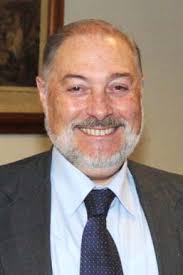
Totti Könnölä, CEO of IFI attended the Foresight Methodology Workshop of the Mineral Intelligence Capacity Analysis Project (H2020) organised by La Palma Research Centre in Las Palmas, Gran Canaria, Spain between 10 and 11 May, 2017.
Transforming Innovation Ecosystems
Totti Könnölä, CEO of IFI attended the Foresight Methodology Workshop of the Mineral Intelligence Capacity Analysis Project (H2020) organised by La Palma Research Centre in Las Palmas, Gran Canaria, Spain between 10 and 11 May, 2017.
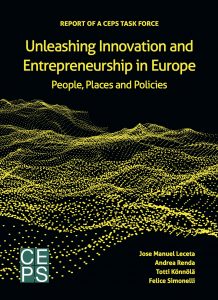
IFI co-authored a book that sets out the elements for the design of a streamlined and future-proof policy on innovation and entrepreneurship in Europe. It is the result of a collective effort led by CEPS, which formed a Task Force on Innovation and Entrepreneurship in the EU, composed of authoritative scholars, industry experts, entrepreneurs, practitioners and representatives of EU and international institutions. The result of these deliberations is a set of policy recommendations aimed at improving the overall environment and approach for entrepreneurship and innovation in Europe and a new paradigmatic understanding of the role that innovation and entrepreneurship can and should play within the overall context of EU policy. These recommendations are based on a new, multi-dimensional approach to both innovation and entrepreneurship as social phenomena and to the policies that are meant to promote them.

The Task Force was chaired by José Manuel Leceta, former Chairman and Co-founder of Insight Foresight Institute (IFI), currently DG of Red.es. Andrea Renda, CEPS Senior Research Fellow, Totti Könnölä, Managing Director and Co-founder of Insight Foresight Institute and Felice Simonelli, CEPS Research Fellow, served as rapporteurs.
image©CEPS

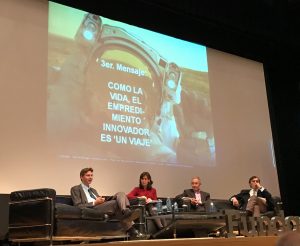
Our Managing Director, Totti Könnölä attended the innovation panel of the the VI General Conference of the Spanish Foundations Association, which was held the 23rd of November of 2016 in the headquarters of the Barrie Foundation in A Coruña, in the framework of the 50th commemorative act of this Galician entity.
Totti made a bet on innovation during his intervention on the round table. “To innovate is, in the last instance, about betting on people”, he suggested. His discourse addressed the challenge of entrepreneurship, innovation, ambition and collaboration. He gave much importance to the last point, and he got to say that “at the end that its not just institutions which collaborate but rather individual persons, and sometimes bonds of complicity are created”, as occurred in a case from his native country, Finland, where the Government “obliged” first companies and the academic world to collaborate for obtaining public funds and, although at first the relationship was “artificial”, little by little links were created between persons which led to effective collaboration. In addition, he indicated that innovation is not just undertaken by the business field, but also science, politics and society. However, he added that “entrepreneurship requires an ecosystem” and that, it is necessary to cooperate and “work hand in hand to advance”. He reflected that in the path of innovation there are risks that have to be accepted and that sometimes also serious difficulties arise; “innovative entrepreneurship is a journey, it always comes with uncertainties, but it has its rewards”. So he encouraged everyone to “have ambition” in their projects.
image© @ClaraNavarroCol
1. IntroductionThe European Institute of Innovation and Technology (EIT) is part of Europe’s most recent efforts to change entrepreneurial innovation policies into successful practices. The EIT exemplifies an experimental shift from today’s EU-level interventions and current emphasis focused on trans-national collaborative projects (in R&D) towards a new paradigm in fostering Pan-European entrepreneurial innovation ecosystems that stresses human capital and attitudes through enabling innovation spaces. The EIT offers an opportunity to learn from European innovation policy experiment to promote the formation of inter-connected local entrepreneurial innovation ecosystems and to innovation in policy more generally in connection with European Union practice. The following constructive remarks are a set of pointers suggesting specific key areas for further progress.
Insights
Demand
Dynamics
Learnings
Perspectives
Summary
N.B. A worth reading reference is (Tindemans and Soete, 2007), whereby a ‘hybrid model’ for EIT with manageable number of partners per KIC was proposed, in between the initial fully centralised EIT/KIC and the adopted fully decentralised EIT/KIC model actually implemented: a so-called ‘Cluster EIT’ model for the KICs would mean splitting too large KICs into more numerous but smaller KICs 2.0 closer to the logic of Co-Location Centres. KICs 2.0 would capture local nature of knowledge, reduce KIC 1.0 overheads and re-set collaboration and competition at EIT level. In addition, the report proposed a ‘European Innovation Fund’, which somehow reminds of the ‘European Strategic Investment Fund’ (ESIF). As the mid-term evaluation foreseen in the Horizon 2020 context approaches, it would be interesting and appropriate for the EIT and KICs to courageously self-evaluate progress and achievements in advance. IFI fully supports the Commission to carry out an independent assessment that would greatly benefit from inputs from all three Knowledge Triangle competent Directorate Generals and observers in the Governing Board, thus recreating balance and providing expertise.

Gonzalo León is a Doctor in Telecommunications Engineering by the Technical University of Madrid (UPM) and a Telematics Engineering Professor in the Superior Technical School of Telecommunication Engineers of UPM. He has devoted his research activity to the development of software systems and in the transfer models of technology, participating in various National Projects and in the Framework Programme of the European Union. He has been General Vice-Director of international relations of R&D and Vice-Secretary of the General National Plan of R+D at the Ministry of Education and Culture and Secretary General of Scientific Policy at the Science and Technology Ministry.
In April 2004, he was appointed as Vice Chancellor of Research in the Universidad Politécnica de Madrid, position that he occupied until December 2013. In January 2013 he is appointed Director of the Technological Innovation Support Centre, position that he still occupies. In January 2013 he was also appointed Deputy to the Chancellor for Strategic Programs until April 2016 in which he is named Delegado del Rector para Partenariados de Innovación.
He has been president and member of diverse expert groups of the European Union. He has presided the Advisory Group for Space Investigation of the Framework Program of R&D of the European Union, the group of experts for the monitoring of the Lisbon Strategy and the Research Infrastructure. He has been a speaker in the High Level Civil Servants Group of the G8 for big scientific facilities. Currently, he is the Spanish representative in the EU FET Flagship “Human Brain Project”.
In the Spanish context, he is the Vice-President of the Technology for Defence and Security Program, and president of the New Technology Commission of CESEDEN. He is Member of the Innovative Companies Forum (FEI) and participates or has participated in the sponsorship of several foundations and administrative councils of companies as a representative of the UPM and the Spanish government.
Insight Foresight Institute (IF-Institute)
C/ Isabel Colbrand 6, Quinta Planta.
28050 Madrid, Spain
info@if-institute.org
tel. +34 600842168