Insight Foresight Institute

Transforming Innovation Ecosystems

  • About us
    • Our Community
    • Follow us and share
    • Contact us
  • Ecosystems
    • Corporates
    • Policymakers
    • Startups
  • Solutions
    • Activation & Alignment
    • Insight Foresight
    • Strategy & Governance
    • Training & Mentoring
    • Programming & Implementation
  • Sectors
    • Education
    • Research and Innovation
    • Services
    • Energy and Environment
    • Health and Social Care
    • ICT
    • Manufacturing
    • Transport and Infrastructure
  • Outreach
    • Press
    • Events
    • Videos
    • Reports
    • Position Papers
    • Follow us and share
  • English
    • Spanish
You are here: Home / Archives for Project Sectors / Security

European R&I Foresight and Public Engagement for Horizon Europe

Insight Foresight Institute coordinated this Foresight on Demand project for DG RTD. It aimed at providing timely foresight intelligence and forward-looking policy briefs to the European Commission for purposes of R&I policy on the following topics:

  • Futures of Civic Resilience
  • Futures of Green Skills and Jobs
  • Futures of innovation and IP regulation
  • Futures of Science for Policy in Europe 
  • Futures of Using Nature in Rural and Marine Contexts in Europe
Horizon-Europe

This project aimed at:

  1. Providing timely foresight intelligence and forward-looking policy briefs to the European Commission for purposes of R&I policy on the mentioned topics.
  2. Providing a hub for Europe’s R&I foresight community and a space in which foresight agencies and researchers can share knowledge and tools.
  3. Networking EU-supported R&I projects with important foresight elements and promoting their results to policymakers, including via Horizon Futures Watch quarterly newsletters.
  4. Promoting broad public engagement with foresight for R&I policy, including stakeholders as well as the public and covering all sections of society, from scientists and engineers to policy-makers, artists, intellectuals and engaged citizens.

Further information

“European R&I Foresight and Public Engagement for Horizon Europe”. In European Commission: Directorate-General for Research and Innovation.

Acess to project information
European R&I Foresight and Public Engagement for Horizon Europe
Futures4Europe Platform

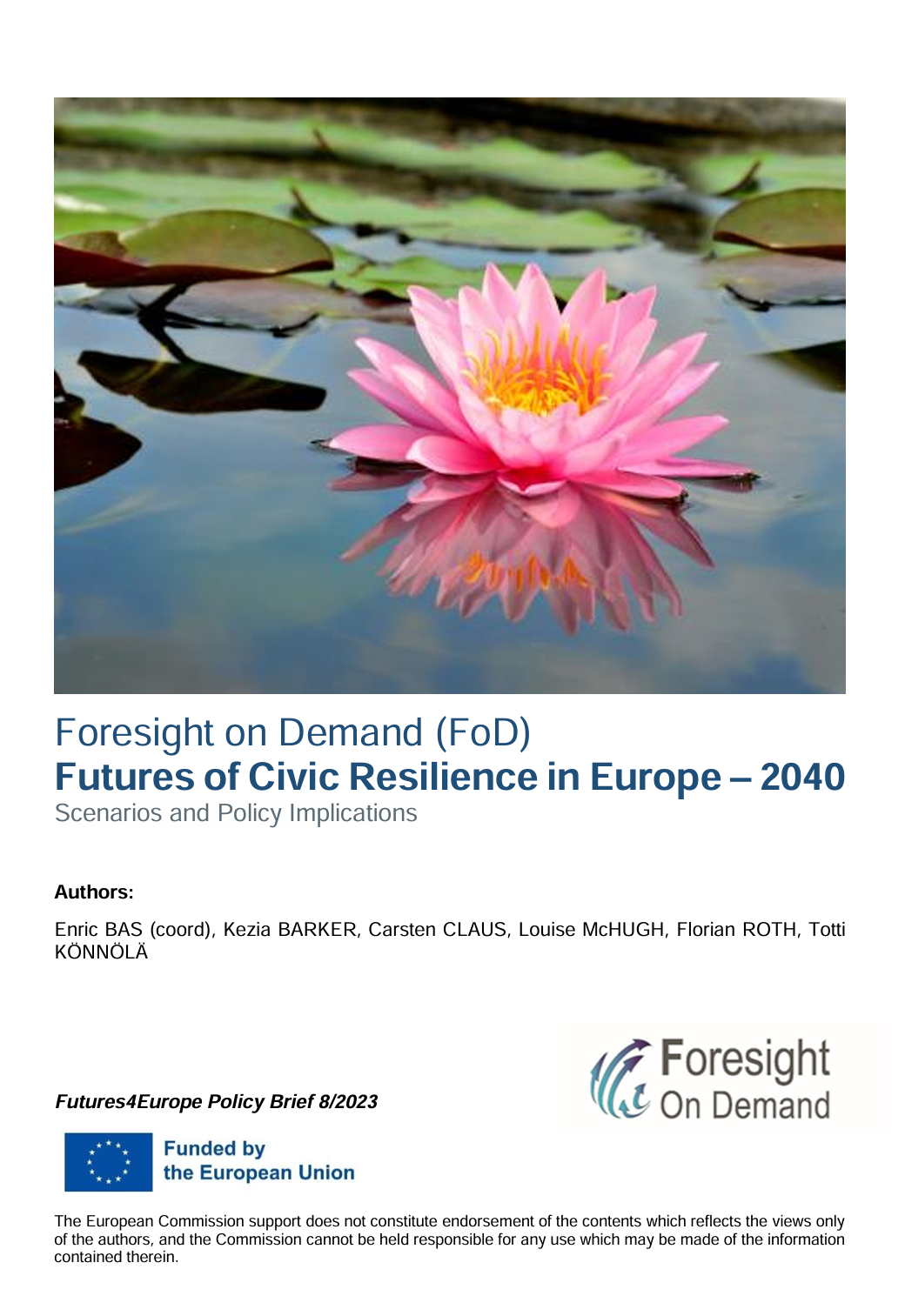
Futures of Civic Resilience in Europe – 2040: Scenarios and Policy Implications

Insight Foresight Institute participated in the Foresight on Demand consortium studying “Futures of Civic Resilience in Europe – 2040: Scenarios and Policy Implications”. The study developed a policy brief exploring four possible future scenarios for 2040 and their implications for current decision-making. Also, recommendations for R&I policy measures were defined to address any given social effect. The work was part of the larger platform project named “European R&I Foresight and Public Engagement for Horizon Europe” for the European Commission, coordinated by Totti Könnölä, the CEO of Insight Foresight Institute.

Civic img1

The brief outlines the major societal challenges which are changing the landscape of the European Union. Since the beginning of the 21st century, the instability of the economy and the difficulty of the EU to respond to it have contributed to the lack of trust among citizens. The report considers civic resilience as the ability of a community to prepare and adapt to adversities. It calls for local commitment, preparedness beyond the support of the public administration and the private sector.

Futures of Civic Resilience in Europe develops four alternative scenarios with the aim of helping policymakers prepare for future crises and strengthen the resilience of civic society today. The scenarios are identified around two main axes (technological & economic adaptation and social & environmental stewardship): 

  • 1st scenario: both axes are high, it is denominated as the ideal future. Low levels of community and individual resilience, civic society would not be ready to face an unexpected event. 
  • 2nd scenario: techno-economic adaptation is low, but socio-environmental stewardship is high. Institutional void, but strong community consensus, which means that citizens are subordinate to the collective, and there is a low level of individual resilience. 
  • 3rd scenario: high techno-economic adaptation meets low socio-environmental stewardship. It represents a risk to the social fabric due to the omnipresence of technology. In a homogenised alienated society where social institutions are annulled, the only possible resistance may come from the individuals. 
  • 4th scenario: it is regarded as the worst-case scenario, where both axes are low. It would be a radical context where both community and individual resilience may be high because hostile environments reinforce the survival instinct. 
Civic img

Keeping in mind the unpredictability of the social effects of technology and the importance of public services and local actors for civic resilience, it is important to engage broadly with actors responsible for public services in the definition of R&I policy agendas. Thus, R&I measures could: 

  • Stimulate a radical social innovation through “glocal” (local but with global impact) creative initiatives. 
  • Identify and define boundaries for upcoming cutting-edge technologies implantation, prioritizing social stability and welfare. 
  • Define agendas in resilience research, oriented to explore new potential needs and new ways of addressing existing needs. 
  • Make existing public services more effective and resilient, for instance, via education and health. 

The study highlights that in addition to R&I agendas, civic resilience can be strengthened by improving governance, local democracy, public services and education policies. 

Further information

Enric Bas, Kezia Barker, Carsten Claus, Louise McHugh, Florian Roth and Totti Könnölä. “Futures of Civic Resilience in Europe – 2040: Scenarios and Policy Implications”.  Publications Office of the European Union, 2024. 

Acess to full report
Futures of Civic Resilience in Europe – 2040: Scenarios and Policy Implications

After the New Normal: Scenarios for Europe in the Post Covid-19 World

The team of Insight Foresight Institute developed this study alongside experts from Fraunhofer ISI and AIT. The study examined five alternative scenarios for Europe in 2040 emerging from the COVID-19 pandemic’s disruption, focusing on their implications for EU research and innovation policy. The aim was to analyze how the pandemic’s amplification of global uncertainties might reshape long-term R&I priorities, and to provide policymakers with strategic perspectives on potential post-crisis evolution paths.

After the new normal photo

Based on extensive literature review and expert workshops, the study outlines five scenarios reflecting divergent futures shaped by the pandemic’s long-term effects on research, innovation, and social resilience. Rather than predicting a single outcome, these scenarios serve as strategic narratives to stimulate policy reflection and guide future decisions, exploring a range of possibilities in economic recovery, political cohesion, and societal transformation.

The five scenarios include:

  • Long Recession – Europe faces sustained economic stagnation, rising nationalism, and shrinking public R&I investments.
  • Back to ‘Normal’ – Attempts to return to pre-pandemic normalcy led to institutional stagnation.
  • Techno-Feudal Europe – Technological power concentrates in private hands, weakening democratic oversight.
  • Circular trials and real-life errors scenario – Economic model based on sharing, leasing, reuse, repair, refurbish and recycling in an (almost) closed loop.
  • Green Utopia – A transformation towards equity and ecological sustainability through coordinated green transitions.
Image 2.1

The authors  outline the core methodology, including horizon scanning and scenario-building. It positions research and innovation (R&I) as central levers for navigating uncertainty and advancing EU objectives. Emphasizing the need for:

  • Control over technological development.
  • Resilience, adaptability and crisis preparedness for times of crises.
  • The key role of education.
  • EU level financing for R&I.
  • Regional disparities in R&I performance.
  • Defining future priorities in R&I policy.

The report concludes with a call to reimagine Europe’s future beyond recovery—to build a more inclusive, forward-looking, and resilient Union. It recognizes that Covid-19 was not merely a crisis, but a pivotal moment to reshape the trajectories of European integration, innovation, and sustainability.

Authors

European Commission. Dictorate-General for Research and Innovation – Kerstin Cuhls (coordination, Fraunhofer ISI), Aaron Rosa (Fraunhofer ISI), Matthias Weber (AIT), Susanne Giesecke (AIT), Dana Wasserbacher (AIT), Totti Könnölä (IFI).

Acess to full report
After the new normal: Scenarios for Europe in the post Covid-19 world. A Foresight on Demand Project.

Foresight services to the European Commission

As part of the consortium led by the Austrian Institute of Technology, IFI supports the European Commission by providing “foresight on demand” services in science, technology, research and innovation policy.

Foresight services to the European Commission


DG Research and Innovation has set-up a “Foresight-On-Demand” (FOD) mechanism to respond to the demand for quick inputs to policy-making, drawn on the best available foresight knowledge. FOD is aimed at offering Commission services with timely and effective support related to crisis situations, emerging risks, and policy challenges. The FOD services will include scanning and synthesis of foresight literature and data sources including horizon scanning, rapid foresight data collection and analysis, scenario building, and combinations of the above. Within this framework, IFI is providing foresight support among others to the Mission Boards, European Environmental Agency and the Commission Scientific Advisory Mechanism and SAPEA.

Insight Foresight Institute (IF-Institute)

C/ Isabel Colbrand 6, Quinta Planta.
28050 Madrid, Spain
info@if-institute.org
tel. +34 600842168


Copyright © 2026 · Insight Foresight Institute · Terms and Privacy · Cookies · Fotos: Shutterstock · info@if-institute.org · Tel. +34 600 842 168
  • English
  • Español
We use cookies to ensure that we give you the best experience on our website. If you continue to use this site we will assume that you are happy with it.